
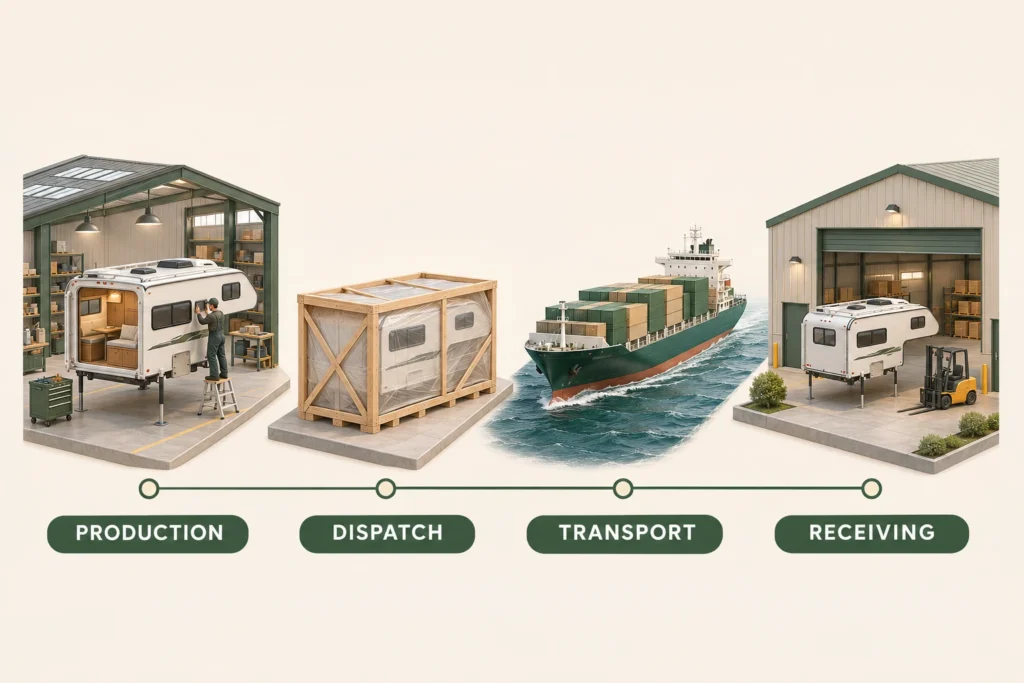
A camper can be finished at the factory before it is available to your dealership, rental fleet, or project team. Between those points, the order may still need an agreed release, transport arrangements, destination handling, and delivery to the receiving location. Planning from the production estimate alone leaves those activities without time in the schedule.
When comparing truck camper production time vs. shipping transit time, define the start and finish of each estimate. Then work back from the date your business needs the camper ready to use. The result should be a milestone plan with named responsibilities and visible assumptions.
Define what the production estimate includes
Huntoo Camper’s stated production estimate is 60–70 working days. Confirm the schedule for the proposed order with sales, including what triggers the count and what milestone marks its completion. Ask how configuration confirmation, buyer responses, and any agreed review fit into that schedule.
Working days and calendar days describe different periods. Request the working calendar used for the order, including how non-working days are treated. Avoid converting the estimate into a fixed arrival date using an assumed weekly pattern.
Keep the production estimate attached to the selected model, quantity, and configuration. The Huntoo furnished camper range is a starting point for identifying the product; the order-specific schedule still needs confirmation.
Separate factory completion from transport departure
Ask what must happen between the agreed production completion milestone and the shipment’s actual departure. Depending on the arrangement, the plan may need time for buyer review, agreed corrections, packing, collection, or transport coordination. Confirm which activities apply and who owns them.
Do not automatically add an inspection period if the supplier has already included it in the production estimate. Equally, do not assume it is included. Identify each activity once and record whether it runs within another stage or follows it.
A proposed departure, a booking, and an actual departure should have separate entries or clearly labeled status updates. Ask the party arranging transport what evidence will support the next schedule update.
Give the transit estimate a specific endpoint
Ask the quoting party where its transport estimate begins and ends. A port-to-port estimate and an estimate ending at a warehouse address cover different scopes. Record the route or service assumption and the destination point beside the quoted timeframe.
Huntoo’s final shipping costs and transit time must be confirmed with sales. Taxes and delivery coverage also require final confirmation. A country name alone is insufficient to establish the complete delivery schedule.
Use the production and delivery information to frame that conversation. Ask sales or the transport provider which activities after arrival are covered by the estimate and which remain to be arranged by the buyer.
Build the schedule around milestones
| Milestone | Meaning to agree | Planning question |
|---|---|---|
| Production count starts | The event from which the supplier counts working days. | Which order decisions or other prerequisites remain open? |
| Production completed | The specific factory milestone covered by the estimate. | Does it include the agreed review, corrections, or packing? |
| Released for dispatch | The agreed point at which the shipment can move onward. | Who confirms readiness, and what must be complete first? |
| Transport departed | The actual departure for the defined transport leg. | Who supplies the update and the revised arrival estimate? |
| Available for receiving | The agreed destination point and receiving conditions. | Which release, handling, or onward delivery steps remain? |
| Ready for business use | The buyer’s own operational readiness milestone. | What inspection, installation, preparation, or handover remains? |
This is a proposed planning structure. Adapt the milestones to the actual order and transport arrangement, and assign a contact to each stage. It does not establish a standard Huntoo dispatch procedure or a guaranteed route.
Work backward from the date the business actually needs
A dealer may need time after receiving to prepare a display unit. A rental operator may need a vehicle-specific installation review, staff familiarization, and a customer handover plan. A project buyer may need an internal receiving appointment and acceptance process.
Write down those tasks before setting the target receiving window. Agree durations with the people responsible rather than allocating one generic allowance to every order. Keep vehicle installation and other technical work subject to the applicable review and qualified providers.
Next, discuss the receiving window with sales and the transport provider. Ask whether the proposed sequence is workable and which assumptions need confirmation. If the business-use date is fixed, make that constraint visible early instead of presenting it as an arrival promise to customers.
Keep allowances and estimates visible
Separate the service provider’s estimate from any planning allowance your business adds. Label the purpose of that allowance, such as completing an agreed buyer review or protecting a fixed project handover. Avoid presenting it as extra time promised by the supplier.
Show a target window while dates remain estimates. For every update, retain the previous forecast, the revised forecast, and the reason given for the change. This helps the purchasing team identify which downstream tasks need adjustment.
If transport arrangements are still preliminary, say so in the internal plan. An expected departure should not silently become an actual event when the schedule is copied into a sales presentation.
Recheck the plan when the order changes
A configuration change, revised quantity, different destination, or new receiving requirement should trigger a schedule discussion. Ask the relevant supplier or service provider whether the existing estimate still applies. Record the response against the current order revision.
Keep customs and destination questions with the forwarder or local adviser responsible for that shipment. Ask what timing assumptions and buyer actions are needed; do not treat a milestone table as confirmation of import eligibility or destination release.
Before sharing a delivery expectation externally, check that the production basis, transport scope, destination tasks, and business preparation are all represented. Use the current milestone plan when answering internal delivery questions.
Planning a camper order for a selling season or project deadline? Send Huntoo your model, quantity, destination, and target ready-for-use window to discuss the production and delivery details needed for your schedule.